







Software Selloff 2026: Valuation Opportunities Emerging After A Historic SaaS Drawdown
Opportunities in the Software Selloff
Given the sharp selloff in technology—particularly across software-as-a-service (SaaS) companies—we wanted to share our current thinking on valuations and where we are beginning to see, or actively look for, opportunity. Some of the companies we discuss below include:
- Booking Holdings Inc. (BKNG)
- Broadridge FinancialSolutions, Inc. (BR)
- Microsoft Corporation (MSFT)
- Salesforce, Inc. (CRM)
- SS&C Technologies Holdings, Inc. (SSNC)
In the coming months, we expect to spend considerable time working through the wreckage, searching for high-quality businesses with durable competitive moats that have been sold indiscriminately as investors appear to be selling first and asking questions later.
We believe the selloff has created opportunity for long-term, patient investors; however, selectivity is critical, and it is important to remember that when sentiment turns against an industry, valuations can fall to levels few would have previously imagined.
Reversal in Leadership
In stark contrast to recent years, Technology is the worst-performing S&P 500 sector so far in 2026, down 5.2% year-to-date versus a 0.5% gain for the index. Somewhat ironically, the driver of this weakness has been technological innovation itself.
The 5.2% decline masks the carnage that some individual stocks have faced as some once high- flyers are down significantly more. The most visible casualty has been the iShares Expanded Tech- Software Sector ETF (IGV), which has decreased approximately 26% year-to-date, with particularly sharp declines in early February following a series of updates from Anthropic to its Claude product suite. Those releases—including an agentic user interface designed to automate office workflows and enhancements to Claude’s reasoning capabilities—served as a catalyst for a sharp selloff across software and information services
This decline stands in stark contrast to IGV’s long-term track record, with cumulative returns of roughly 358%, 551%, and 879% over the past 10, 15, and 20 years, respectively—far outpacing the broader market.
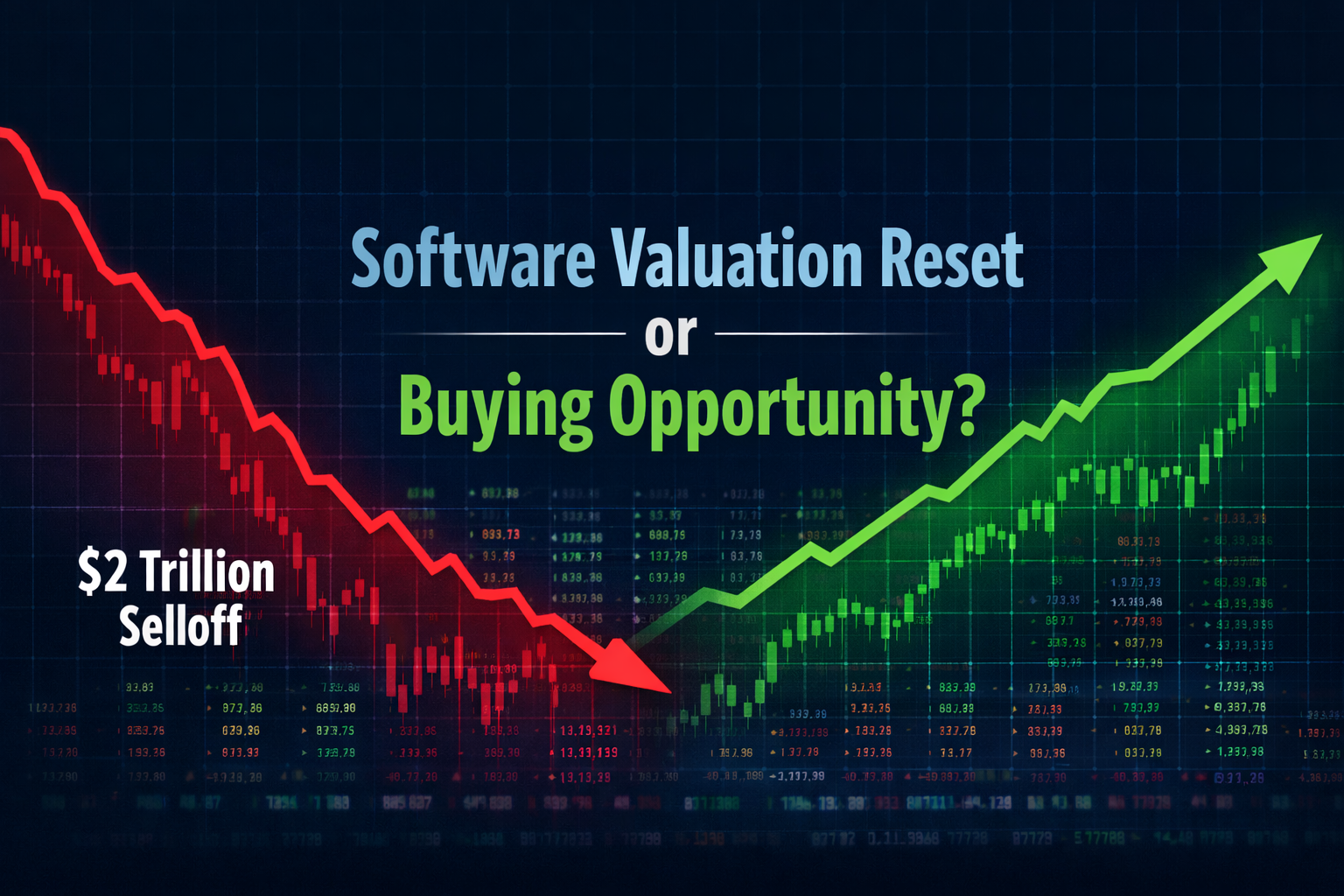
According to JP Morgan, this has been the industry’s largest non-recessionary drawdown in more than 30 years, and with market cap losses of ~$2 trillion, software’s weighting in the S&P 500has dropped from 12% to 8.4%.
Entire categories—including enterprise software, vertical market software, information services, and online classifieds—have been swept up in a single narrative: that AI will disintermediate large portions of the software value chain.
Disruption Risks Are Real…
For many years, software businesses have commanded premium valuation multiples, reflecting capital-light models, recurring revenue, high margins, and perceived defensiveness. We may indeed be witnessing a regime shift. If AI materially reduces seat counts, compresses pricing, or absorbs incremental functionality that historically drove software upgrades, it is conceivable that certain business models face structural multiple compression.
In that scenario, some software stocks may never revisit their prior highs.
…But Indiscriminate Selloffs Create Opportunity
As is often the case, the market has moved well ahead of fundamentals in certain stocks. Jefferies analyst Jeffrey Favuzza recently dubbed the environment the “SaaSpocalypse,” where investors are simply selling everything, regardless of price.
At Boyar, we always care about price. We are increasingly seeing high-quality, deeply embedded software franchises—many with long operating histories and strong free-cash-flow profiles—trading at valuations we would characterize as unusual, and in some cases, unprecedented.
Below are a few thoughts on names we have previously profiled.
Salesforce (CRM)
Salesforce entered the recent turmoil already under pressure, largely due to concerns that the per-seat SaaS model may be vulnerable if AI drives workforce efficiency. While that risk exists, we believe the narrative is overly simplistic.
Salesforce has already begun migrating toward consumption-based, value-based, and hybrid pricing models—most notably with Agent force and Data Cloud—where customers purchase credits that are consumed based on usage. If anything, AI-driven activity could increase data volumes, workflow complexity, and mission-critical reliance on Salesforce’s platform.
Importantly, Salesforce maintains approximately 21% global CRM market share—roughly four times that of its closest competitor—and is deeply embedded across sales, marketing, service, commerce, and data workflows. Ripping out Salesforce is nota trivial exercise.
Somewhat paradoxically, Salesforce partners with Anthropic to power portions of its own LLM and agentic offerings—suggesting that advances in Claude enhance Salesforce’s value proposition rather than undermine it.
Salesforce has never been “cheap.” Over the past five years, it has traded at an average of roughly 30x forward earnings. Today, shares change hands at approximately 14.5x forward EPS.
SS&C Technologies (SSNC)
SS&C is being painted with a broad brush amid fears that AI will automate fund administration, middle-office, and back-office workflows.
We believe this view underestimates the importance of accuracy, auditability, and regulatory compliance. Asset managers cannot tolerate errors.“ Human-in-the-loop” models—paired with verified systems—remain essential.
SS&C has been proactive in developing its own automation capabilities, including its acquisition of Blue Prism. Management estimates that internal deployment of automation has already generated over $100 million of annual cost savings, with additional efficiencies ahead, while simultaneously creating new automation-based revenue opportunities for clients.
Moreover, SS&C’s contracts are typically long term (2- to 5-years)and are priced on a number of factors other than merely the number of users, including more defensive pricing models based on CPI escalators, AUM, transaction volume, and asset complexity.
The midpoint of 2026 guidance suggests 12% adj. EPS growth to around$6.86 per share. At roughly$77 per share, SS&C trades near 11x forward earnings.
Booking Holdings (BKNG)
AI is increasingly viewed as a threat to online travel intermediaries, and it’s very likely that the way people organize their travel plans will change—including through the use of AI agents. But we expect Booking to remain a key part of the transaction process.
Booking is a trusted brand that integrates with millions of individual properties worldwide, and its booking platform and customer service have proven difficult to replicate—including by well- capitalized competitors such as Google and Tripadvisor.
It has built an impressive loyalty program (Genius) and roughly mid-60%of bookings now originate from direct channels, including more than half via Booking’s mobile app—creating a recurring, high- margin customer relationship that does not depend on how users search.
Further, Booking is agnostic to how consumers search for a property and uses any platform that generates an appropriate ROI to generate incremental demand—including traditional search (which continues to grow), social media, and emerging LLM channels—including as a partner in Open AI’s ChatGPT app store.
CEO and 25-year company veteran Glenn Fogel has successfully guided Booking through prior structural shifts, including from desktop to mobile and then to apps, and his decision to make key investments during the pandemic has accelerated the Company’s growth rate. Guidance is for high- single-digit revenue growth and mid-teens EPS growth, and yet Booking now trades at <16x next-twelve- months earnings, among its lowest levels ever.
Broadridge Financial Solutions (BR)
Broadridge has recently come under pressure as uncertainty around AI, digital assets, and the tokenization of securities has weighed on sentiment — the stock is down more than 30% from its recent 52-week high. Those fears are understandable: change in market infrastructure can be disruptive and creates short-term volatility. Yet the narrative that tokenization or AI will simply destroy incumbents oversimplifies the situation and likely overstates the downside risk to a company embedded in the plumbing of the financial system. Historically Broadridge has been a prime beneficiary of digital disruption. Over the past two decades it captured much of the value created by the migration of shareholder communications from print to digital. Its Investor Communications segment (about 74% of revenues) occupies a near- dominant(~80%) position in proxy and interim communications processing, handling communications representing a meaningful share of outstanding stock and achieving roughly90% digital penetration for many regulatory communications. Those entrenched positions are not easily replicated and help create strong base of recurring revenues (revenue retention rates are in the high 90s%).
Far from being a victim of the new technologies, Broadridge argues the opposite: AI and tokenization are growth drivers. The company is integrating AI into new products to lift engagement and to automate repetitive tasks, improving efficiency across its operations. On tokenization, Broadridge says it already facilitates more than $400 billion in tokenized trades — more than any other provider — and views tokenized instruments as still being securities that carry the same servicing obligations (proxy, class actions, corporate actions, tax, etc.) that its platform is built to deliver. That combination of distribution, product integration, and regulatory know-how makes the firm well positioned to capture incremental revenue as the market evolves.
The business model reinforces the investment case. Broadridge is more like core market infrastructure provider rather than a typical SaaS vendor— it moves money and securities and sits at the center of key post-trade workflows — and more than 90% of its fee revenue is recurring, with the remainder largely event-driven but repeatable. Given that stability, the current valuation looks compelling: shares trade at roughly 18x forward earnings, more than a 20% discount to its 10-year average of about 23x. In short, while near-term uncertainty is real and has been punished by the market, Broadridge’s entrenched market positions, product relevance in a tokenized world, and highly recurring fee base suggest the sell-off may overstate the long-term risk.
Companies on our Radar Screen
Historically, we have admired many software and information-services businesses but often found valuations lacking an adequate margin of safety. That is changing.
We have previously profiled companies such as Guidewire Software (GWRE), whose shares are roughly 54% below their 52-weekhigh; and Microsoft Corporation (MSFT), about26% below its 52-week high. While Microsoft’s P/E ratio has hovered around 30x for much of this decade, at roughly 22x earnings the valuation is becoming interesting again.
We are now taking a fresh look at those names as well as companies across vertical-market software and workflow-embedded platforms. One example is Roper Technologies (ROP),whose shares are down over 40% from peak levels and whose P/E multiple has roughly halved over the past five years to a 15-year low, despite owning a collection of mission-critical, niche software franchises.
The Road Ahead
Some software business models will face real disruption. Others will adapt, evolve pricing, and leverage AI to deepen customer relationships and expand addressable markets.
In the coming months, we expect to spend considerable time scouring the wreckage—seeking companies with durable moats, deeply embedded workflows, strong cash-generation, and management teams that understand how to incorporate AI rather than being displaced by it.
History suggests that periods of narrative-driven capitulation often prove fertile hunting grounds for long-term investors. We believe this episode will be no different.
If you have any questions, please do not hesitate to contact us at info@boyarvaluegroup.com or call us directly at (212) 995-8300.
Important Disclaimer: This materialdoes not constitute an offer to sell or a solicitation of an offer to buy anyof the securities described herein in any state to any person. In addition, thediscussions and opinions in this letter and the material contained herein arefor general information only and are not intended to provide investment advice.All statements contained in this letter that are not clearly historical innature or that necessarily depend on future events are "forward-lookingstatements," which are not guarantees of future performance or results,and the words "will," "anticipate," "believe,""expect," "potential," "could,""opportunity," "estimate," and similar expressions aregenerally intended to identify forward-looking statements. The projectedresults and statements contained in this letter and the material containedherein that are not historical facts are based on current expectations, speakonly as of the date of this letter and involve risks that may cause the actualresults to be materially different. Certain information included in thismaterial is based on data obtained from sources considered to be reliable. Norepresentation is made with respect to the accuracy or completeness of suchdata, and any analyses provided to assist the recipient of this material inevaluating the matters described herein may be based on subjective assessmentsand assumptions and may use one among alternative methodologies that producedifferent results. Accordingly, any analyses should also not be viewed asfactual and also should not be relied upon as an accurate prediction of futureresults. All figures are unaudited estimates and subject to revision withoutnotice. Boyar Asset Management disclaims any obligation to update theinformation herein and reserves the right to change any of its opinionsexpressed herein at any time as it deems appropriate. Boyar Asset Managementclients and its employees own shares of BKNG, BR, MSFT, CRM, & SSNC.
Boyar’s Intrinsic Value Research LLC Copyright 2026.