



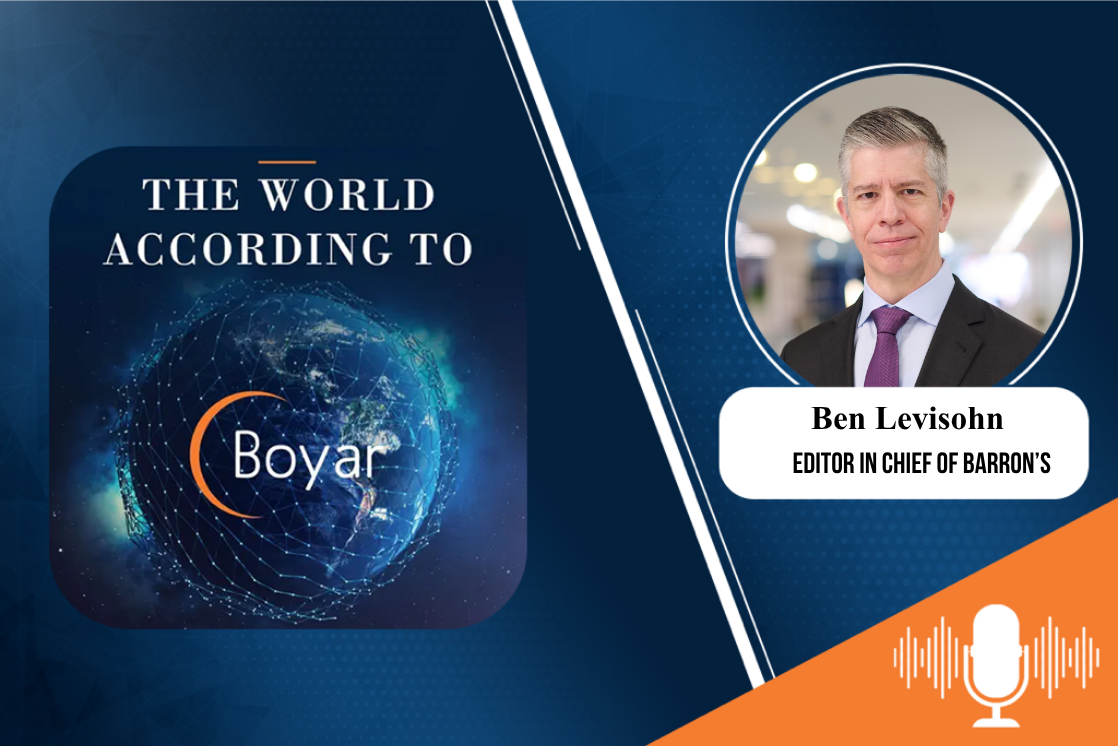




Ben Levisohn, Editor in Chief of Barron's: How a Story Gets Chosen and Why AI Won't Write It
The editor in chief of Barron's on stock picks, the "Barron's bump," AI in the newsroom, and where Barron's is headed.
I've been reading Barron's for as long as I can remember, and our firm has been fortunate enough to be the subject of a few of its stories. But I had always wondered how a story is chosen, so I asked the person who chooses: Barron's editor in chief, Ben Levisohn.
We go behind the scenes to find out how a cover story gets picked, where the ideas come from, whether clicks matter, and why Barron’s so rarely tells readers to short a stock. I also asked how it feels to move markets with the "Barron's bump," the jump a stock often gets on Monday morning after Barron's recommends it over the weekend. When I asked why stock picks so rarely come with position sizing, Ben said adding that kind of risk context to Barron's picks is on the table.
Ben also explains how Barron’s uses AI, and why it won’t let AI write its stories. The reason isn’t just about quality. It’s also about lawsuits and copyright.
We finish with where Barron's is headed: a community where readers can talk directly with reporters, and Ben's goal of making Barron's the first place anyone turns with an investing question, not just Wall Street and financial advisors.
What we cover:
- From preschool teacher and aspiring musician to proprietary trader in 1998, and the pivot to journalism that led him to the top job at Barron’s
- How a Barron’s cover story gets chosen, and where the ideas come from
- The sources he looked for as a reporter: no perma-bulls, no perma-bears, no spin
- The “Barron’s bump,” when Barron’s tells readers to sell, and why short calls are so rare
- Why Barron’s stock picks could start coming with risk context, and why a model portfolio is unlikely
- Why an AI bust could look more like 2008 than the dot-com crash, and what worries him about private credit
- How he uses AI to test reporters’ pitches, and the legal reasons AI doesn’t write Barron’s stories
- Why Ben thinks AI won’t shrink the newsroom, but will force reporters to find the stories AI can’t
About the guest:
Ben Levisohn is the editor in chief of Barron's. He joined Barron's in 2012 as an emerging-markets writer, wrote the Streetwise and Trader columns for a decade, and served as deputy editor and senior managing editor; he led the 2025 launch of Barron's Investor Circle. Before Barron's, he covered markets for The Wall Street Journal and Bloomberg. Earlier, he spent more than seven years as an equities trader. He is a graduate of the University of Chicago and the CUNY Graduate School of Journalism.
Links:
- Barron's: www.barrons.com
- Barron's Investor Circle: www.barrons.com/investor-circle
- Boyar Research on Substack: https://boyarresearch.substack.com/
Transcript of the Interview With Ben Levisohn
[Jonathan Boyar] (0:04 - 0:47)
Important disclosures and disclaimers apply to this episode. Please listen to the end of the episode for the full disclaimer. I'm Jonathan Boyar and this is The World According to Boyar.
As a longtime reader of Barron's, one of Wall Street's most influential publications, I've always been curious how they decide what to feature both online and in the print edition. So I asked the editor-in-chief, Ben Levisohn, to come on the show and explain it. We cover that and a lot more, including the legal reasons Barron's won't let AI write its stories.
I hope you enjoyed the show. Ben, welcome to the show.
[Ben Levisohn] (0:47 - 0:49)
Thanks, Jonathan. It's great to be here.
[Jonathan Boyar] (0:49 - 0:54)
You've had an unusual career path and you started out as a preschool teacher, right?
[Ben Levisohn] (0:54 - 0:55)
That's right.
[Jonathan Boyar] (0:55 - 0:59)
Then you went to proprietary trading. Why become a preschool teacher?
[Ben Levisohn] (0:59 - 1:28)
I came out of college and I really didn't have much of an idea of what I wanted to do with my life other than maybe playing my guitar and write songs. And so for really the first three years out of school, I was playing music, started a band with my brother, played together in the basement. I supported myself by teaching preschool and ended up doing that for three years and it was great.
Learned a lot, especially about the differences between people and things like that, but there was a came a point where I really decided, you know what, this is not where I want to be spending the rest of my life.
[Jonathan Boyar] (1:28 - 1:30)
Why become a proprietary trader?
[Ben Levisohn] (1:30 - 2:01)
It's really just the opportunity. It was 1998, dot-com boom is going full speed ahead. Everyone's making money.
The technology for trading had changed so much. I had a friend who had grown up with in Denver. He's working for one of these day trading proprietary shops, doing really well.
He's making as much money in a day as I am in a month. He's like, you know, you can come out to New York and trade stocks and play music in the afternoons if you want to. And I was 25 and it seemed interesting.
So I took him up on it.
[Jonathan Boyar] (2:01 - 2:04)
Did you know anything about being an investor then?
[Ben Levisohn] (2:04 - 4:38)
I cared nothing about the market at all. At that point, my first education was having to study for the Series 7 exam. It's when you have to take to become a registered broker I'm having flashbacks, what a terrible test.
It was awful. Just so much information. That was my first real introduction to the financial markets having to be able to pass that test.
And then it was really just a question of being thrown into the markets. I ended up trading New York Stock Exchange stocks, which was a different game than my friend had been doing trading the NASDAQ. They still had the specialist on the floor, an actual human who was matching up trades and so it was a different way of doing things.
It was really learning on the job how to spot stocks that you thought would go up or stocks that you thought would go down that you could short and trying to manage risk through it all. Was it fun? I loved researching the stocks in the morning and the afternoon.
The big thing every day was finding which stocks would be in play. We need to find the ones where people would be really pushing them up or down. It didn't matter which.
But you could lose a lot of money by trying to trade a stock that really didn't have direction and you just end up churning it all day and costing yourself money because you had to pay commissions on each trade and whatnot. I loved that part of the day. Come in, you look at what got upgraded, what got downgraded, what had earnings, what had other news on it and try to figure that out.
That part was fantastic. The trading part I found, my personality worked against me on it. I'm a little bit of a nervous guy sometimes and I had a friend who traded the exact same way I did, but he always made more money and the reason was he would see what he needed to do and he would just hit the button.
I would see what I needed to do and then I would flinch for just like a split second there and then I'd hit the button. But that tiny little millisecond of indecision actually cost me money. So he would make twice as much money as me every year, even though we were doing basically the same thing.
It taught me a lot about my own personality, what I'm good at and also how to overcome some things that I have in my own personality. Did you read Barron's when you were there? The best thing about this is that every Friday, our boss would go over the loudspeaker and say, all right, go home, get your copy of Barron's and read it over the weekend and come in with ideas to trade and he really did sound like that.
So we would go home, we'd read the issue, try to see what stocks would be moving because Barron's had mentioned them and that was my first real exposure to the magazine was through that. It was so influential, it moves the markets, everybody was waiting to see what Barron's would recommend and that stuck with me all through my trading time.
[Jonathan Boyar] (4:38 - 4:45)
But even as I left trading to go into journalism and what made you go into journalism, did you just get tired of trading? Like what happened?
[Ben Levisohn] (4:45 - 5:16)
Well, I always knew that I wasn't going to be in trading forever. As I said, it wasn't the right fit as a job as long as I was making a lot of money doing it. It was great.
But a couple of things started happening. One is that the market went from sixteenths to pennies and that really changed how we'd been trained to trade. And then we were also trading against the specialist and as the specialists were pushed out in favor of purely automated trading, what we'd learned to do just didn't work anymore.
And so I could see what was happening to my earnings. They're just going down in the wrong direction.
[Jonathan Boyar] (5:17 - 5:23)
And when you went to journalism school, did you know you wanted to be a financial journalist or you just weren't sure at that time?
[Ben Levisohn] (5:24 - 5:51)
I knew it was either going to be a financial journalist or I was going to be an arts music kind of journalist. But it was quickly apparent that because of my trading, I had a skill set that others didn't have within the business field. And that really was powerful.
It made the journalism part of it a lot of fun. I mean, to be honest, business journalism is also where the jobs are between the fact that I had an edge, I found that I can actually write in very creative ways within the business journalism. It just made it make a lot of sense for me.
[Jonathan Boyar] (5:52 - 6:02)
You had a couple of jobs before going to Barron's, but you started I think in 2012 as an emerging markets blogger, what was the day in the life of a young journalist at Barron's?
[Ben Levisohn] (6:03 - 6:39)
It was so interesting because I didn't find myself as a journalist until I became a blogger. One thing that I've kind of realized is I like taking in information and responding to it quickly. So the job worked really well for me.
Basically that'd come in in the morning, get in early and I'd look for all the news that was happening emerging markets, particularly in some of the ADRs that were very popular at the time. What was interesting about the job is this was basically when emerging markets were peaking as a thing. I would look at what stocks were moving and write and it would be writing five, six, seven posts a day just on whatever was interesting and moving.
[Jonathan Boyar] (6:39 - 6:47)
So you became a day trader in 1998, 1999 and you started writing about emerging markets in 2012. So your timing is interesting.
[Ben Levisohn] (6:48 - 7:49)
One of the great things, my best year as a trader was actually on the downside of when the dot-com boom became a dot-com bust. Shorting stocks was a lot of fun. We used to joke that a stock could get it too expensive to buy, but it could never get too cheap to sell.
So if you caught a stock that people were just like, oh my God, I have to get out. It just went straight down and you could make a lot of money. And there was a lot of that during the first year of the bust.
I think with emerging markets, it was kind of the same thing happening is that everyone was so excited about emerging markets and China and whatnot. And then I got to sort of realize, oh, wait, this is kind of peaked as a trend as it was both the stocks themselves, but also the interest. The money flowing into emerging markets also started to pull back.
And so I was wrestling in real time with kind of what was happening with the emerging market trade broadly. And that was a real education about how to think about taking in the short-term information and turning it into articles, but also thinking about how does this short-term information, what does this signal about the longer term?
[Jonathan Boyar] (7:49 - 7:57)
Were you able to write kind of short pieces as well if you had started having a view that emerging markets were not the place to be? Was that allowed?
[Ben Levisohn] (7:57 - 8:27)
One of the great things about the position was I was blogging all day, but Barron's was still really magazine first at that time. And we still are. And the magazine is really the centerpiece of what we do, but I also had an emerging markets column.
That was my place to take everything that was happening during the week that I was blogging about and turn it into something that was more of a step back that could look forward. The combination of the two was very powerful. I think it was that being able to do both of those things is what really set the course for me to end up in this seat.
[Jonathan Boyar] (8:27 - 8:33)
What does an editor-in-chief actually do? What's a day in the life of the editor-in-chief of Barron's?
[Ben Levisohn] (8:34 - 9:46)
It's my job to set the vision to really steer the course. I mean, I think Barron's what we have is we know what we're good at. In my mind, we're an investing magazine.
So how do we execute that? Most of my days are spent trying to make sure that we're staying on that course. It's very easy to get caught up in things that I think don't matter for investors.
There's a lot of noise out there. And so I think my job one is to make sure that, hey, are we thinking about the stories that really matter to people who are trying to make decisions with their money? And how do you do that?
Taking lots of information, listening to what editors and reporters are coming up with, we're meeting, we're talking, we're really trying to watch what's happening, talk to smart people, trying to get lots of different views. And we're doing almost the same thing I was as a blogger, where we're doing stories that are daily stories, trying to understand what's happening like this week, what's happening with CoreWeave, the AI trade. We're trying to understand that in real time.
Well, I'm thinking about also, what does it mean going forward for the next year? What does it mean for the market overall? And I think that's partially what my job is to do, is to try to make sure we're spotting the right things, and then we're able to take that news and turn it into the bigger think pieces that we are really known for.
[Jonathan Boyar] (9:47 - 9:50)
And who are you writing for? Like what's the typical Barron's reader?
[Ben Levisohn] (9:51 - 10:25)
The typical Barron's reader is someone who likes the markets, likes to invest, and wants to be able to do it themselves. They might have an advisor but want to understand what the advisor is doing and why and ask the right questions. They might be someone who wants to do the investment all by themselves, and are looking for ideas.
What should I buy? What should I sell? How should I allocate?
And so it typically tends to be someone who has the money to do that. But it's someone who really does have that interest and has maybe a little longer term view, we're not really for the day trader. We're for someone who has money and wants to put it to work for the longer term.
[Jonathan Boyar] (10:26 - 10:29)
Most people now consuming it digitally, I'm assuming.
[Ben Levisohn] (10:29 - 11:05)
Yes. The digital subscribers vastly outnumbered the print. But I think the print is still a very important component of what we do.
I think both as setting the tone for what Barron's is, there's always been this kind of ritual of people picking up that magazine on their doorstep every Saturday morning. They get a cup of coffee and they sit and they read. And I like to think of that as the Barron's community.
We're trying to think about how do we recreate that in a digital format? Because we do have so many more subscribers now that are coming to us online. But I think they want the same thing that the print subscribers want as well.
And so how do we meet those needs?
[Jonathan Boyar] (11:06 - 11:18)
How are you going to try and get a sense of community? How do you do that? Especially on a topic like stocks that you're passionate about them.
But it's not necessarily a community based forum.
[Ben Levisohn] (11:19 - 12:10)
One of the things we're trying to do is we've created the Barron's Investor Circle. And this is for readers who really do want more of Barron's. So part of it is giving them more stock picks.
But we're also launching a community component to it, where it's a place where they can come. They can start conversations and ask questions in a digital form and reach out to editors or reporters. And hopefully they'll talk to each other.
They'll talk to us. We'll go back and forth. If we pick a stock and they have questions about it, our reporters are there to answer.
If they have criticisms, our reporters are there to answer. They'll be able to share their own ideas and get feedback from other readers and from staff here at Barron's. So the idea is to try to bring these people who really do care about investing are thinking about different stocks, thinking about it long term, that it becomes a place where they can get good information, share good information and really be doing it with like-minded people.
[Jonathan Boyar] (12:11 - 12:18)
That's a big change in a reporter's job. What's been the reaction or what's the thought process among the rank and file, I guess?
[Ben Levisohn] (12:19 - 13:06)
It is a big change. But I think it reflects what's happening in journalism, where you've gone from sort of the faceless publication, where you would read the Wall Street Journal or you read Barron's. And it's the Barron's brand that matters.
I think what's happened is that people that are reading do want to have some sort of relationship with the reporter that's writing. They want to know who it is. They want to know what that person thinks and see them as someone that's not just a faceless person typing away.
So you see that with our best reporters, really do enjoy getting involved with our readers to take in what they're saying. And I think it comes fairly naturally for many of them. It is different than what journalists have been required to do in the past.
But they do see themselves as a chance to be themselves in a way that you might not have always been as a journalist in the past. And that could be a lot of fun.
[Jonathan Boyar] (13:07 - 13:29)
Before we continue, if you're enjoying this conversation, I'd encourage you to subscribe to our Substack at boyarresearch.substack.com. That's where we share some of our research, all of our interviews, and our thoughts on investing. Now back to the conversation.
And just taking a step back in terms of the actual magazine, how does a story make it in?
[Ben Levisohn] (13:29 - 14:46)
A lot of it depends on what we're trying to do, but let's take the magazine in that cover story because the cover is where we're planting our flag. We're saying that this is an important story that you need to know about. The process for that is pretty rigorous.
We have people, they come in, they pitch ideas, we'll sit down and we'll talk it through. We don't want to reject stories. We want to find the right Barron's story inside of all these pitches.
And so we'll talk through exactly like, okay, what makes this a Barron's story? What is it that readers need to know? Why now?
What's the angle that is important? We had a great example of this recently with our story about the tokenization of stocks and how this is going to be a massive change for the markets in a way that digital trading was back in the 2000s. And it took us a little while to get the angle right.
We had to talk that through to, you know what? Let's go with, this is the biggest change. And that's what we went with.
And so most of the stories, they're coming out of our reporters, they're doing the work, they're coming up with ideas. And then it's a question of how do we frame these? And what do we think are the most important things?
Sometimes it's a company, sometimes it's an investment theme. Sometimes we decide, you know what? This week something happened in the news that's so big, we better do a story right now.
But it's really trying to identify that story that is most important to our readers and finding the right way to tell it.
[Jonathan Boyar] (14:46 - 14:55)
Are the story ideas coming originally from the journalist? Are they coming from like professionals like myself? Are they coming from publicists?
How does that part work?
[Ben Levisohn] (14:56 - 15:41)
It comes from all of that. In many ways, it comes from journalists talking to people like yourself. For stock picks, it very much might be, oh, I just talked to someone.
They had a really good idea for a stock pick. I'm going to go research it myself and talk to others about it, try to confirm that, yeah, this is good an idea as we think it is. For others, it's just reporting, finding information that others don't have.
We see that with some of the stories that we've done around the prediction markets, where we got some information that others didn't have in terms of donations being made to gambling help organizations, and that becomes the story. It comes from everywhere. We're just trying to talk to as many people as we can, watch the markets closely, read everything, and find the ideas that aren't really out there yet.
[Jonathan Boyar] (15:41 - 15:43)
And how do you decide who to talk to?
[Ben Levisohn] (15:44 - 16:31)
I think every reporter has their own way of doing it. As a reporter, I would talk to everybody that was offered to me. People would come and say, hey, could you talk to this person?
And I would take every interview because I never knew who would be the one that I would click with and find what I would need. At the same time, I was always searching for people on my own to try to do. And it was really all about finding sources as a markets reporter who would talk to me honestly about what they were seeing in the markets.
I didn't want the perma-bulls. I didn't want the perma-bears. I didn't want the ones who would just talk the consensus.
I needed to find people who are really wrestling with what the market was doing, where it was headed, which parts to invest in, which stocks looked best. So I was just looking for the ones that we could have these honest conversations about things. And I didn't have to worry that they were just giving me spin.
[Jonathan Boyar] (16:31 - 16:39)
When you decide to write a story, how much does clicks matter in terms of, hey, this is going to be a well-received one?
[Ben Levisohn] (16:40 - 18:06)
There are some stocks that the bar is lower to write about. NVIDIA, if there's news, we're probably going to write it. There's interest there.
But I also believe that any stock, any story can be made interesting. We might have to work hard to do it. We want our stories read.
I mean, that's kind of the point of being a journalist is to have people read our stories and find them interesting. But I think any subject can meet that. How do you make a story about a stock interesting?
You look for that thing that others aren't seeing about it necessarily. Sometimes it's easy. There's a cover story that we did in 2024 on Alphabet.
And this is when it was peak Alphabet fear that the stock was going to go away because of AI. And Al Root, it's one of our reporters here, pitched a bullish story on, is saying that these fears are overblown. And sometimes it's that simple.
It's like, OK, what's going on like that? But other times it's finding a business where they're doing something that you didn't know was interesting. Maybe it's ball bearings.
And you find the fact that this ball bearings company is actually making something that is needed for the AI trade. And all of a sudden that becomes interesting. So it's really just finding that angle in a company that allows you to tell a story that people want to read.
Well, at the same time, you need to be right on the direction or trying to be right on the direction. You are telling people that this is a good stock. So you're trying to find the way to make it interesting.
Well, at the same time, trying to get that risk reward correct for the pick itself.
[Jonathan Boyar] (18:07 - 18:24)
Internally, we call it the Barron's bumps. Sometimes on a Monday, you'll see a stock open up five, six, seven percent, whatever it is because it was featured in Barron's as a reporter or an editor. Like, how does that make you feel?
Are you like, wow, that's really cool? Or I don't want to influence this. Like what's the thought?
[Ben Levisohn] (18:25 - 18:50)
It's both. It's nice to know that when people read us, they do take our opinion seriously. That's our way of seeing that in real time.
At the same time, there have been small caps that we've picked that have moved a lot. And you think, wow, that's more than it should be moving off of this pick. Because what we do want is we want to pick something and our readers have time to read the stories, think about it, act on it.
And if it moves too much, they're not going to get to do that.
[Jonathan Boyar] (18:50 - 18:53)
Does Barron's ever really tell readers to sell a stock?
[Ben Levisohn] (18:53 - 19:24)
We've done both. We will tell people to sell stocks that we've recommended. We're doing follow-ups.
If we feel like they've gone up too much, we'll say, hey, it's time to take profits. Or if we pick something and it started going down and we think our thesis on this was just wrong, we'll pull the pick. We've also recommended some shorts.
We don't do it very often, but Andrew Bary, who's one of our great reporters, he's been here for more than 40 years, had a couple of years ago of some really great short picks, one in Costco that he picked the top and for the right reasons. And so we will. Yeah.
[Jonathan Boyar] (19:24 - 19:27)
Why don't you do more short reports? Is there a particular reason?
[Ben Levisohn] (19:28 - 20:20)
Two reasons. One is that they are very difficult. You have to really find a stock that you think is completely out of whack with valuations that the business is being read incorrectly.
But the other problem with them is that timing is so important. The market goes up most of the time, trying to take a stock that has been doing well, but we think people have gotten wrong is tough. But some of our best calls have been shorts going back to Andrew Bary.
I mean, he predicted the bankruptcy of Linn Energy back when the energy bust happened in the 2010s with MLPs. This is one of these MLPs where at the time they were just talked about as being toll road. It's like, oh, there's no risk here.
They just take the natural gas from one place. They move it to the next place. It's a toll road.
It's a great business. And everybody loved them for the dividends. Andrew was able to spot the flaw in that argument and actually timed it well.
But it's very difficult to do.
[Jonathan Boyar] (20:20 - 20:32)
I love Andrew's stories. Anytime you write something, I'll definitely read it. He does a great job.
And you guys also, I think I could be wrong, came close to the top on the dot-com bubble. I could be wrong in that.
[Ben Levisohn] (20:32 - 20:57)
We did. Yeah, that was picking up on one stat. This was just the cash flow burn, the cash burn at these dot-com companies.
And we spotted it and said, and I was even here then. So I'm not sure I had to say we, but Barron's spotted it and did this story. And it was in March of 2000 and it was right near the top.
That's what we do best is when we can find that data that really pushes against the narrative. That's where we do our best work.
[Jonathan Boyar] (20:57 - 21:01)
That was worth the subscription price many times over. That's right.
[Ben Levisohn] (21:03 - 21:20)
Well, and that's the best part is when we do get readers who say, hey, you wrote about X stock and I bought it and it's worked out great and paid for my subscription. You know, that's what we're here for is to provide ideas. Hopefully our readers go and they look at what we said.
They do some of their own research and then decide whether to buy.
[Jonathan Boyar] (21:21 - 21:39)
A couple of months ago, I had Josh Brown on the show who I really like. And he said, one thing that they don't do is talk about position sizing. Always people are talking, I love this stock, but they don't say, oh, this should be a three, four, five percent position, whatever it is.
And I think that's critically important. How come Barron's doesn't do that?
[Ben Levisohn] (21:39 - 22:21)
It's actually something we've talked about as we started this Investor Circle. One of the things that we've realized is we need to get more sophisticated in our thinking about the stocks. We're very good at saying, hey, buy or sell.
But one of the things that we will introduce at some point is also thinking about the risk in the stocks. Is it a high beta? Is it low beta?
And if it is high beta, are you ready for that kind of volatility that will have in it? And so I think as an investor, that is such an important thing. As a trader, it was all about that.
You would start with the position. If it was going in your direction, you would add to the position. And if it was going against you, you'd get out.
And so I think that is something that we've thought about as we transformed how we're picking stocks and is something that's on the table for us.
[Jonathan Boyar] (22:21 - 22:38)
One of the ways that people used to get a whole bunch of good stocks, you used to do these really long form interviews. Going back to the 80s, 90s, maybe early 2000s, there were five, six pages. What made you guys stop that?
And would you consider bringing it back?
[Ben Levisohn] (22:38 - 24:14)
What's interesting is we still interview fund managers a lot. The difference is that they aren't five to six pages anymore. They're two to three.
I think that represents two things that are happening. One is that for the most part, most people are not reading five page stories anymore. They want their information to be a little shorter than that and a little more succinct.
And so we're trying to give the same kind of content, get a good fund manager in, talk about stocks. And then we do our roundtables, which actually are the one place where we do break the rule about keeping things to three, four pages. Whether it's the big Barron's roundtables or we do the subject roundtables during the year, where we get a number of people in to talk about stocks.
And so we try to do it, but just in a way that is more digital-friendly, more, I guess, 2020s than it would have been 2000s. Are you allowed to own stocks personally? We are not.
That is a rule of Dow Jones that for the most part, there are some exceptions where people own stocks. They're not allowed to write about them. But almost every reporter that's been hired at Barron's or at Dow Jones does not own a single stock.
We basically have that rule in place because we don't want there to be any conflicts, even just the possible ones that you're not even aware of. If we don't own the stocks, we can't be pushing them. We can't even be writing stories that push them from the side door kind of thing.
The argument that could be made against that is that if you have your own money at stake, you might think harder about the picks. But I think because of the way we do pick stocks, that this is very much using journalistic tools to do stock picking, that I think it works pretty well. The teams do a lot of digging and it really keeps us from having any conflicts.
[Jonathan Boyar] (24:15 - 24:19)
Is there anything in the market now that really concerns you?
[Ben Levisohn] (24:19 - 25:02)
I do think that this combination of Fed rate hikes simultaneously with these concerns about the AI trade is a really scary moment. It'll be interesting to see how it resolves itself. But so much was dependent on, oh, the Fed is not going to do anything.
And this AI trade is going to go for another three to four years. And so hey, just keep investing. This has been a wake up call for people that things don't always go as smoothly.
And what works doesn't always keep working. I mean, think when you see like the chip trade, when those stocks are gaining 100, 200, 300% in a six month period, you probably have to be step back and say, you know what, maybe I need to take some profits here. But I do worry about that right now.
I think it is a little more fraught than we've been in a while.
[Jonathan Boyar] (25:03 - 25:15)
You started your career, I guess in 1998, but you lived through the dot-com bust. Any parallels now? Is that something you're worried about with AI or do you think it's smooth sailing from here?
[Ben Levisohn] (25:15 - 26:25)
I worry about it a lot in the same way that you had the fiber optic cables being laid and everybody was just building out as much as they could. And then the order started getting canceled. And I think you have to worry about that with chips and the data centers now.
You know, everyone's backed up. You can't get enough chips. But if those orders start getting canceled, that's a real warning sign.
I think the big difference is that the dot-com bust was not a credit event. It was really an equity event. These were companies that had raised money with stocks and the stock market was going up.
So when it popped, it was a stock market event, not a financial markets event. And what worries me about this boom that we're having with AI is that this is very much about credit as well. Seeing all these massive tech companies go from having massive free cash flow to being cash flow negative, that's kind of scary to see them taking on debt, see all these other companies taking on debt to know that private equity and private credit, they're adding debt into this market to build these things.
That is a frightening aspect that in some ways makes me worry that when this ends, and if it ends, is it going to be more like a 2007 to 2009 financial crisis than bubble bursting?
[Jonathan Boyar] (26:25 - 26:28)
Does private credit worry you a lot? Do you think there could be a bubble there?
[Ben Levisohn] (26:28 - 27:02)
I just think the fact that there's so much money that is opaque, that we don't know who owns the debt, who's borrowing it. I think we probably know how much is out there, but it's hard to know. I think it just worries me that so much is off balance sheets are in places where it's not visible.
And that's where I think we learn from whether you go back to the savings and loan crisis or you go to the financial crisis 2008, 2009, that it's not knowing what people really own how much they owe. That's where you start really running into problems.
[Jonathan Boyar] (27:02 - 27:14)
Almost every earnings call, conference call, what not is how are you implementing AI? So I'm going to use that. How is Barron's utilizing AI to make a better publication?
[Ben Levisohn] (27:15 - 28:29)
We are using it and Dow Jones is a big believer in using AI to build efficiencies. One thing that we will not do and we don't do is use it to write or edit our stories. That is all done by a human being.
I think this goes back to the conversation we're having about community and comments. We want our readers to know that these are people writing stories, writing what they think, that the words on the page are theirs. So when you read a story, you'll know that it's been written by a human.
It's been edited by a human. But there's so much that we are using it for in terms of making the newsroom more efficient in terms of planning. I use it actually a lot to make sure that our reporters are doing stories that AI can't do.
If someone pitches a stock story, I can easily go to AI and say, can you tell me why I should or shouldn't buy this stock? And if AI gives me an answer that's very similar to what my reporter has pitched, I have to tell my reporter to go back to the drawing board, you have to find new information, not the information that someone could get just by going to Gemini or ChatGPT or Claude and asking. And so that's a big part of what we're doing.
And then people will use it for research, trying to find documents, trying to find reports that are out there.
[Jonathan Boyar] (28:29 - 28:37)
Is there a copyright reason as well on the why you don't use ChatGPT or Claude or what not to write?
[Ben Levisohn] (28:37 - 29:18)
With using AI tools generally, we have to be very careful because there are certain programs we can't use because they save the text that is put into them on their servers. So it becomes a legal issue. If they're subpoenaed, if we're getting sued and one of these companies is subpoenaed, they could turn over early versions of stories.
They won't even question it. And so we want to have the control over that kind of thing. The other part is that I think it's unclear still how much of an AI contribution could be made before you lose the copyright before it becomes something that is just public domain because AI was involved.
And so by not using AI, we can say, hey, this is a human produced story and it has full copyright protections.
[Jonathan Boyar] (29:19 - 29:28)
In terms of reporters, you think there'll be more or less of them going forward because of AI or will their jobs just change?
[Ben Levisohn] (29:28 - 30:23)
The jobs are going to change, but I think they'll be just as many. They're going to have to work hard. That's what AI is teaching us is that the AI has an incredible ability to find information and to pull it all together.
So if all we're doing is providing the commodity news, that straight earnings story, Microsoft stock gained 5% because earnings beat expectations. AI at some point will probably write all those stories everywhere in the world. But that really gives us an opportunity because it means that everybody can turn to what I find to be more interesting stories.
It's like trying to connect the dots between things, trying to find the connections that AI can't find, talk to the people that AI can't talk to, gather information that AI doesn't have access to. And so for reporters, I think that means we need just as many. We need to be smart.
We need to work hard. We need to think deeply about what the stories are going to be because we have to make sure that they're stories that AI can't do for us.
[Jonathan Boyar] (30:24 - 30:34)
Last question. You're now editor in chief of Barron's two, three, four years from now. What success?
What makes you say, hey, I did a great job and job well done?
[Ben Levisohn] (30:35 - 31:02)
I really want Barron's to be the place where if people have questions about investing, Barron's is where they turn. And that could be on individual stocks, that could be on portfolio allocation, what funds to buy, even just to think about the market and which direction it's going. But that's what I want Barron's to be.
We have this great reputation on Wall Street. We have a great reputation with advisors, but I'd like other people, people just on the street to think, oh, if I have an investing question, Barron's is really the place for me to go.
[Jonathan Boyar] (31:02 - 31:10)
Ben, this was a lot of fun. Thank you for coming on. Where can people learn more about you and learn more about the Investor Circle and anything else?
[Ben Levisohn] (31:10 - 31:33)
Well, come to Barrons.com as we're in the comments all the time. So if you have questions, leave them in the comments. You can also find our email addresses or our most stories.
Come and ask us questions. I mean, that's I think one of the great things about a publication like Barron's is that we are small enough that we are going to take every question that comes in, every subscriber or concern. We take very seriously.
We want to bring people in and be part of our community.
[Jonathan Boyar] (31:33 - 31:34)
Thank you again. I really enjoyed it.
[Ben Levisohn] (31:35 - 31:36)
Thanks, Jonathan. Appreciate it.
[Jonathan Boyar] (31:38 - 32:01)
Provided by Boyar's Intrinsic Value Research. For general informational purposes only, it should not be construed as investment advice. Any opinions expressed herein represent current opinions of Boyar Research only.
Boyar Research assumes no obligation to update or revise such information. Investing in securities involves risk, including the possible loss of principal. Past performance does not guarantee future results.
Employees of Boyar Research or clients of an affiliate may own shares in any company discussed.
Disclosure:
This podcast is for informational and educational purposes only and should not be considered investment advice, a recommendation to buy or sell any security, or an offer to provide investment advisory services. The views expressed by guests are their own and do not necessarily reflect the views of Boyar Research or its affiliates. Boyar Research, its affiliates, employees, and accounts managed by its affiliates may own shares of companies mentioned in this episode. Our views are subject to change at any time, and we are under no obligation to update listeners if our opinions or positions change. Investing involves risk, including the possible loss of principal. Listeners should do their own research and consult with their own financial, tax, or legal advisors before making any investment decisions.
The Boyar Value Group: Uncovering Investment Opportunities Since 1975
Founded in 1975, The Boyar Value Group has spent more than five decades seeking to uncover undervalued opportunities in the stock market.
Through Boyar Research, we provide in-depth, independent research focused on businesses we believe are misunderstood, underfollowed, or trading at a meaningful discount to intrinsic value.
Our investment management business applies that same research-driven discipline to manage portfolios for both institutions and individuals, utilizing our private equity approach to stock market investing.
To learn more about The Boyar Value Group, please visit www.boyarvaluegroup.com.
Never miss another Boyar podcast, market insight, or other valuable content — subscribe to our Substack at boyarresearch.substack.com.